
Write It All Down
On being a historian of your own life.

“If I die, you have to publish all my journals as a book.”
Mark was shocked at my request, as he had assumed that my journals were full of personal musings that I would never want shared with the world. He’s right in a sense; I wouldn’t want them read by the people in my life while I’m still around. But I can’t help but feel that my lifelong dedication to the craft of journaling deserves some kind of posthumous recognition.
When I was a kid, my journals were also deeply private. I scrawled the word across the front of my black-and-white composition notebooks in sharp capital letters, just like I had seen Michelle Trachtenberg do in one of my favorite movies, Harriet the Spy. It was released in 1996 when I was five years old and just learning how to write my own name. My friends and I became obsessed with the film, endlessly watching and re-watching the Nickelodeon-orange VHS tape.
My sister and I were quick to pick up a journaling habit, scribbling our thoughts and observations on lined pages with a secret code plucked out on each upper right-hand corner, just like Harriet. The movie satisfied the itch for our next childhood fixation, but it also taught us — my sister, me, and a whole generation of young girls — that writing is powerful. When Harriet’s notebooks, filled with brutally honest thoughts about her classmates, are made public, she faces real consequences. She loses friendships, becomes ostracized at school, and suffers academically.
However, with some prodding from a child psychiatrist as well as her nanny “Ole Golly” (played by Rosie O’Donnell), Harriet seeks forgiveness from her peers and is appointed editor of the school newspaper, publishing her spy observations as well as an apology for the unsavory things she had written in her notebooks. Harriet’s writing was not only a form of creative expression, but able to affect change in her world.
In an emotional TikTok video mourning Trachtenberg’s recent death at age 39, content creator Tefi Passoa describes the character of Harriet as someone “who saw everything in their life as an adventure” and “who showed me what journaling was.”
“She showed up in the world but she also showed us the consequence of seeing the people around her as characters in some play versus real people,” Passoa continues.
For Millennials who grew up idolizing Harriet, journaling came full circle with the wellness boom of the 2010s. The popular “5 Minute Journal” was released in 2013, and suddenly, it seemed like every influencer was sharing their journaling practice. The cultural focus on self-care was only heightened with the onset of the COVID-19 pandemic in 2020, and suddenly, journaling became cool again.
I truly don’t believe any of it would be possible without Harriet, and, in turn, Michelle.
In the years since Harriet the Spy, journaling has remained a steady force in my life. My crystal-embellished diary with a lock and key evolved to a black soft-cover Moleskine, my gel pen became a Bic rollerball. Over two decades and hundreds of pages, I can watch my handwriting transform from sloping scribbles to the equivocal half-cursive of so many Millennials. My journals contain lists, mournings, musings, brain dumps, essay ideas, miscellaneous phone numbers I needed to jot down. There is anguish and joy and boredom. There is naivety and bravery and fear and hope.
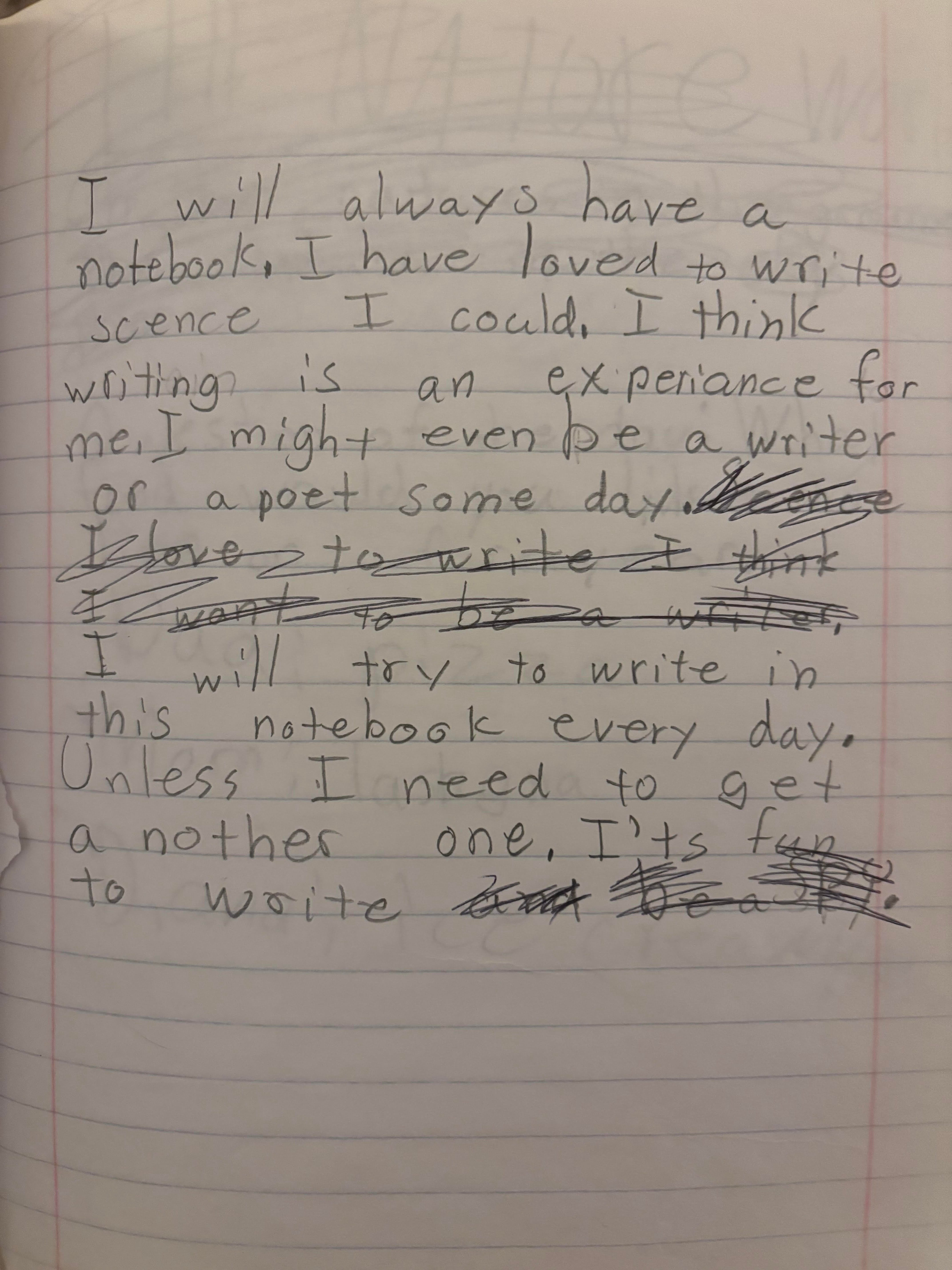
I have since made writing my career. As a journalist and essayist, I have long felt a pull to the art of writing, one that I can trace back to Harriet with a continuous line. Days before Trachtenberg’s death, I randomly decided to rummage through my stack of childhood notebooks. One entry from circa 1998, written in my slanty print riddled with misspellings, reads, “I will always have a notebook. I have loved to write since I could. I think writing is an experience for me. I might even be a writer or a poet someday. I will try to write in this notebook every day. Unless I need to get another one.”
My grandmother was also an avid journaler, and no doubt influenced me to continue the habit. I didn’t realize the extent of her practice until after her death in 2023. She left behind boxes and boxes filled to the brim with spiral notebooks that documented her daily life, everything from doctor’s appointments to phone calls. She also left a collection of essays that my cousin lovingly compiled into a book, a token of her legacy and prolificacy.
It’s such a rare and wonderful gift to get to read someone else’s journals, one that should never be taken lightly. The mundanity of life becomes sacred within the pages of someone’s notebook.
If you’re as fascinated as I am by peeking into the lives and brains of strangers (and by that I mean, you’re also a little nosy), may I recommend these books:
Notes to John by Joan Didion (2025) — A diary written to Didion’s late husband John Dunne, spanning from 1999 to 2003. The entries detail sessions with Didion’s psychiatrist, with whom she was working through her struggles with depression as well as her daughter Quintana’s alcoholism. There’s been some (valid) discourse around the ethics of the book, whether Didion would have wanted something so personal published. Still, I found the collection a heartbreaking portrayal of the lengths a mother will go to help her child.
Madly, Deeply: The Diaries of Alan Rickman (2022) — An intimate look into Rickman’s life and career that I found so delightful. The entries begin in 1993 all the way to 2016, the year of his death. If you’re a Harry Potter stan like myself, you will very much enjoy all the behind-the-scenes details from the sets of the films over the years.
Alphabet Diaries by Sheila Heti (2024) — This book features Heti’s diary entries over a 10-year period, with the sentences arranged from A to Z. What at first seems to be confusing and chaotic becomes, by the end, fascinating, brilliantly poetic, and deeply resonant.
the notebook pic!!
I loved reading this!!! Brought back so many memories!